

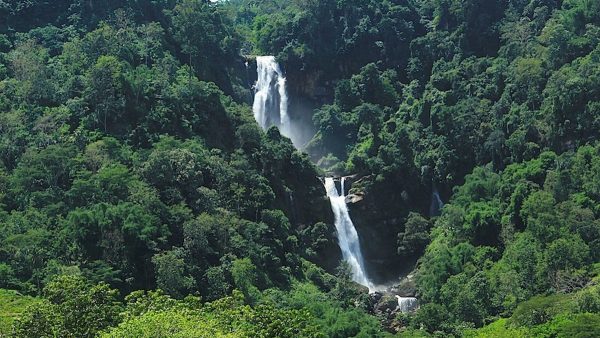
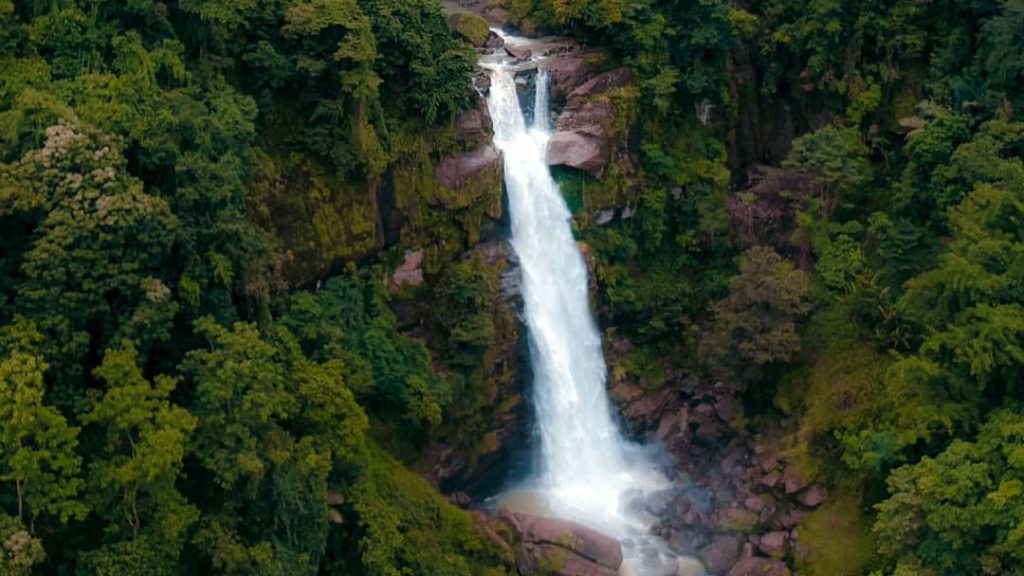
Cunca Lega Waterfall — also known as Tengku Lese Waterfall — is one of Flores’ most striking and least-visited natural attractions. Located at approximately 700 metres above sea level in the hills of Manggarai Regency, this two-tiered cascade drops 25 metres through lush tropical forest into a clear natural pool below. The surrounding scenery of verdant rice paddies, deep forest, and rolling hills adds layers of beauty that make the journey here as rewarding as the destination itself.
Moreover, Cunca Lega Waterfall sits close to several other notable attractions in the Ruteng area, including Liang Bua Cave and the Lingko Spider Web Rice Fields. As a result, it makes a natural addition to any itinerary exploring inland Flores beyond the beaches and islands of Labuan Bajo. This guide covers everything you need to plan your visit to Cunca Lega Waterfall, from how to get there and what to expect, to the best time to visit and what to bring.
Quick Facts: Cunca Lega Waterfall (Tengku Lese)
Alternative name: Tengku Lese Waterfall
Location: Tebo Village, Pasah, North Rahong District, Manggarai Regency, East Nusa Tenggara (NTT)
Waterfall height: Approximately 25 metres (two tiers)
Altitude: Approximately 700 metres above sea level
Natural pool depth: Approximately 3 metres
Pool circumference: Approximately 5 to 8 metres
Entry fee: IDR 2,000 – 20,000/person (verify before visiting)
Nearest town: Ruteng (approximately 40 km / 3 hours by road)
Best time to visit: April to October (dry season)
Where Is Cunca Lega Waterfall?
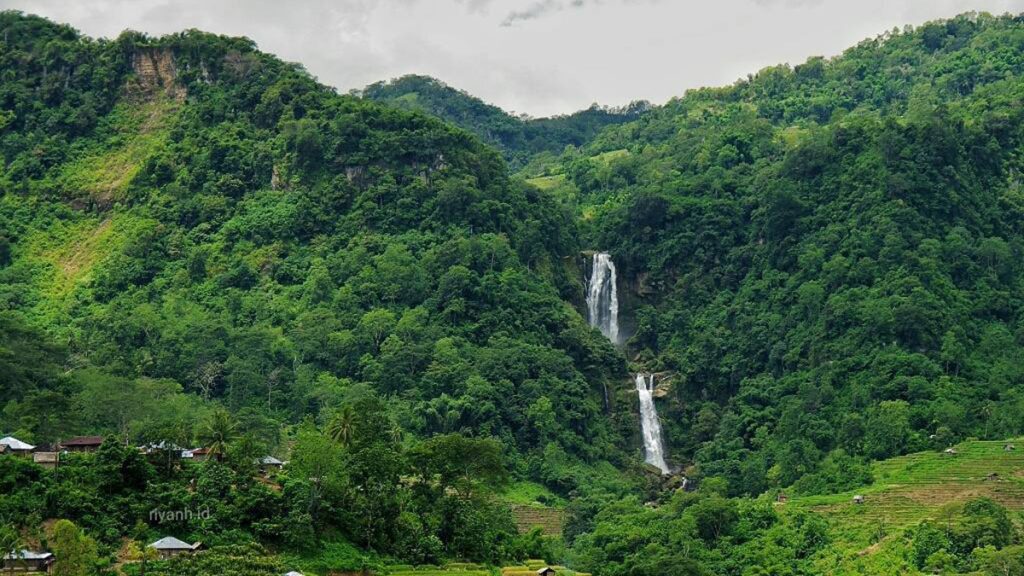
Cunca Lega Waterfall is located in Tebo Village, Pasah, within the Tengku Lese village area, North Rahong District, Manggarai Regency, Flores, East Nusa Tenggara Province. The waterfall sits approximately 700 metres above sea level, nestled within a landscape of dense tropical forest and traditional rice-farming communities.
Furthermore, the setting around Cunca Lega is distinctly different from the coastal and savannah landscapes of the Labuan Bajo area. Here, the vegetation is dense and green, the air is cooler, and the sound of rushing water and birdsong fills the surroundings. In addition, the waterfall is bordered on its western side by forest belonging to communities from Kampung Bonar and Pong Lengor villages, while the eastern side opens onto the rice paddy lands of Rangges and Tengku Lese villages.
This combination of forest and farmland creates a visually rich and culturally interesting environment that rewards visitors who take the time to travel inland from the coast.
How to Get to Cunca Lega Waterfall
Cunca Lega Waterfall is accessed via the town of Ruteng, the main hub of inland Flores. The journey from Labuan Bajo involves a longer road trip than the Cunca Rami or Cunca Wulang waterfalls. Plan for a full day at a minimum.
From Labuan Bajo to Ruteng
The drive from Labuan Bajo to Ruteng takes approximately 3 to 4 hours by car or motorcycle along the Trans-Flores highway. The road is paved and passes through some of the most scenic highland landscapes on the island. In addition, Ruteng itself is a pleasant town with accommodation, restaurants, and ATMs — a practical overnight base for exploring multiple attractions in the area.
From Ruteng to the Waterfall
From central Ruteng, Cunca Lega Waterfall is approximately 40 kilometres away. The journey takes around 3 hours by motorcycle or car, following the road toward North Rahong. The route passes through the village of Nanu, Buar, arriving at the Tengku Lese waterfall area via a 2.5-kilometre approach road from the main junction.
Furthermore, the final stretch of road toward the waterfall passes through scenic rice fields and forested hillsides. This section of the drive is particularly beautiful. Visitors arriving from Ruteng can also use Liang Bua Cave as a reference point — the waterfall lies approximately 15 kilometres from the cave.
Transport Options
- Rental motorcycle: The most flexible option for exploring the Ruteng area independently. Roads are manageable for experienced riders.
- Rental car with driver: More comfortable for groups or those less confident on motorcycles. A driver familiar with the area is an advantage.
- Local guide from Ruteng: Guides available from Ruteng can assist with navigation and add cultural context throughout the journey. Strongly recommended for first-time visitors.
Cunca Lega Waterfall Entry Fee
Entry Fee: Cunca Lega Waterfall (Tengku Lese)
Entry fee: IDR 2,000 – 20,000/person
Local guide assistance: Available from village communities along the route
Entry fee range is approximate and subject to change. Confirm the current rate upon arrival. Hiring a local guide is recommended and directly supports the surrounding communities.
The entry fee for Cunca Lega Waterfall is among the most affordable of any natural attraction in Flores. Furthermore, the waterfall is managed by the surrounding village communities. As a result, paying the entrance fee and engaging local guides directly contributes to the livelihoods of families who live in this area.
What to Expect at Cunca Lega Waterfall
The Two-Tiered Waterfall
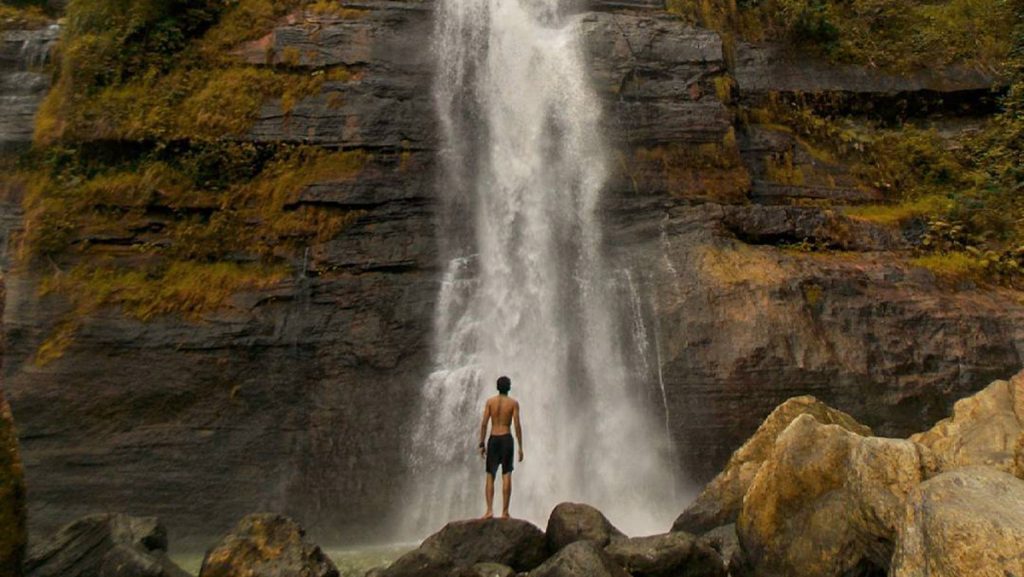
Cunca Lega Waterfall drops in two distinct tiers, reaching a total height of approximately 25 metres. The two-tiered structure creates a more complex and visually interesting fall than a single-drop cascade. Furthermore, the split in the flow creates a spray effect that fills the air around the pool with cool mist, particularly on warm days.
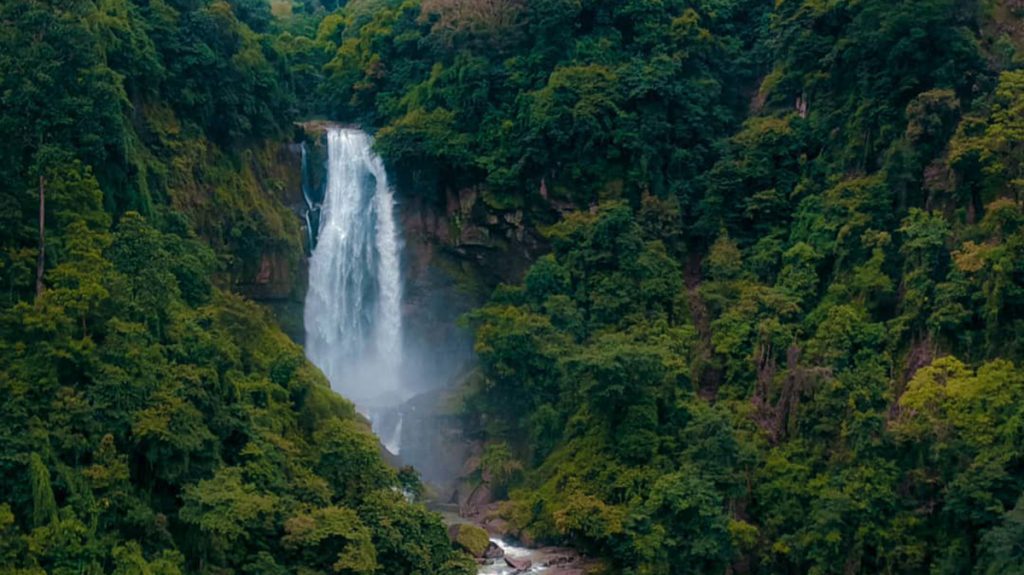
The waterfall sits within a natural amphitheatre of green forest and rock. Lush vegetation clings to the cliff walls on either side of the falls. In addition, the sound of the water can be heard from some distance before the waterfall itself comes into view, building anticipation during the final approach on foot.
The Natural Pool
At the base of the waterfall lies a natural swimming pool approximately 3 metres deep and 5 to 8 metres in circumference. The water is clear, cool, and refreshing — a welcome contrast to the heat of the journey. Swimming in the pool is one of the main attractions for visitors, and the conditions are generally safe for confident swimmers during the dry season.
Furthermore, the pool is shallow enough at its edges to allow non-swimmers to wade in and enjoy the cool water without risk. Children should remain supervised near the pool at all times, particularly near the centre where the depth increases.
The Morning Rainbow
One of Cunca Lega’s most celebrated natural phenomena is a rainbow that appears in the mist of the waterfall during morning hours. When sunlight enters the gorge at the right angle, the spray from the falls refracts the light into a vivid arc of colour above the pool. This phenomenon is most visible between approximately 9:00 am and 11:00 am on clear days during the dry season. As a result, arriving in the morning is strongly recommended for those who want to experience this effect.
The Surrounding Landscape
The views approaching the waterfall are as beautiful as the destination itself. The route from the road passes through a panorama of terraced rice fields, forested hills, and traditional village settlements. Furthermore, the contrast between the bright green of the rice paddies and the darker forest canopy creates a visual richness that is characteristic of highland Flores.
In addition, the communities living near the waterfall cultivate the land using traditional farming methods that have remained largely unchanged for generations. This cultural dimension adds depth to the natural experience of visiting Cunca Lega.
Nearby Attractions to Combine with Cunca Lega Waterfall
Cunca Lega Waterfall sits within easy reach of several other notable attractions in the Ruteng area. Combining visits makes for a highly efficient and varied day itinerary.
Liang Bua Cave
Located approximately 15 kilometres from Cunca Lega, Liang Bua Cave is one of the most archaeologically significant sites in Southeast Asia. It is the cave where fossils of Homo floresiensis — a prehistoric dwarf human species unique to Flores — were discovered. A visit here pairs naturally with the waterfall for a full day of natural and cultural exploration.
Lingko Spider Web Rice Fields
The Lingko rice fields near Ruteng are one of the most distinctive agricultural landscapes in Indonesia. The fields are arranged in a circular, web-like pattern radiating from a central point — a design method unique to the Manggarai culture. The view from the surrounding hillside is extraordinary, particularly in the early morning when mist still lingers over the paddies.
Cunca Wulang and Cunca Rami Waterfalls
For waterfall enthusiasts, both Cunca Wulang and Cunca Rami Waterfalls are within the broader Manggarai region and can be included in a multi-day inland Flores itinerary. Each waterfall has a distinct character — Cunca Wulang is known for its dramatic rock formations, while Cunca Rami is celebrated for its deep forest setting.
Best Time to Visit Cunca Lega Waterfall
Dry Season: April to October (Recommended)
The dry season is the best overall time to visit Cunca Lega Waterfall. Roads are in better condition, the pool is safer for swimming, and the morning rainbow phenomenon is most visible on clear days. Furthermore, the landscape of rice fields and forests is particularly beautiful during this period.
Morning Hours: Best for the Rainbow Effect
Arrive at the waterfall between 9:00 am and 11:00 am on a clear day to maximise the chance of seeing the morning rainbow above the pool. The light is also most photogenic during these hours. As a result, planning to depart Ruteng early — by 7:00 am or 8:00 am — is strongly recommended.
Wet Season: November to March
During the wet season, the waterfall is at its most powerful as rainfall increases the flow considerably. However, the access road can become muddy and difficult, the pool may be less safe for swimming due to stronger currents, and cloud cover often obscures the morning rainbow effect. The wet season is better suited to experienced travelers with flexible itineraries.
What to Bring to Cunca Lega Waterfall
Because Cunca Lega Waterfall is in a remote area with no nearby shops or facilities, preparation is important. Here is what to pack:
- Food and water: No vendors are available at the waterfall site. Bring sufficient food, snacks, and at least 1.5 litres of water per person.
- Swimwear: The natural pool is one of the main attractions. Pack a change of clothes for after swimming.
- Sturdy footwear: The path to the waterfall and the surroundings can be muddy and uneven. Wear closed-toe shoes with a good grip.
- Sunscreen and insect repellent: Apply before departure. The journey involves outdoor exposure for several hours.
- Lightweight rain jacket: Highland Flores’ weather can change quickly. A light layer is useful insurance.
- Camera or waterproof phone case: The waterfall, pool, and surrounding landscape are highly photogenic. Protect your device from spray near the falls.
- Cash (IDR): For the entrance fee, guide, and any food purchased in Ruteng before departure. No ATMs are available at the waterfall.
- Offline maps: Mobile data coverage is limited in the Tengku Lese area. Download maps before leaving Ruteng.
Essential Travel Tips for Cunca Lega Waterfall
- Base yourself in Ruteng for at least one night to explore the waterfall and surrounding area at a comfortable pace.
- Depart Ruteng early — by 7:00 am or 8:00 am — to reach the waterfall during the morning rainbow window of 9:00 am to 11:00 am.
- Hire a local guide in Ruteng or from the village near the trailhead. Navigation in the area is difficult without local knowledge.
- Bring all food and water from Ruteng. There are no vendors at or near the waterfall.
- The pool is suitable for swimming during the dry season, but check current conditions with your guide before entering the water.
- Download offline maps before leaving Ruteng. Mobile data coverage is unreliable in the Tengku Lese area.
- Combine the visit with Liang Bua Cave and the Lingko Spider Web Rice Fields for a full day of inland Flores exploration.
Ready to Visit Cunca Lega Waterfall?
Cunca Lega Waterfall is one of those destinations that rewards the effort required to reach it. The combination of a two-tiered cascade, a clear natural swimming pool, the possibility of a morning rainbow, and a surrounding landscape of rice fields and tropical forest makes this one of the most distinctive waterfall experiences in all of Flores.
Furthermore, its remoteness is part of its appeal. Visitor numbers remain low, the setting is genuinely unspoiled, and the community-managed access means that your visit directly benefits the local families who call this remarkable landscape home. For more ideas on exploring inland Flores, visit the official Indonesia Tourism guide to Flores.
FAQs
They are the same waterfall. Cunca Lega is the Manggarai language name, while Tengku Lese refers to the village area in which the waterfall is located. Both names are used interchangeably by locals and in travel literature. This guide uses Cunca Lega as the primary name, with Tengku Lese included as an alternative for search purposes.
The waterfall is significantly further from Labuan Bajo than the Cunca Rami and Cunca Wulang waterfalls. The journey involves approximately 3 to 4 hours of driving to reach Ruteng, followed by another 3 hours to reach the waterfall from Ruteng. As a result, visiting Cunca Lega as a day trip from Labuan Bajo is not practical. An overnight stay in Ruteng is strongly recommended.
Yes, with appropriate supervision. The pool at the base of the waterfall is accessible, and the shallow edges are safe for wading. However, the centre of the pool reaches approximately 3 metres in depth, and children should be supervised at all times near the water. The approach road and surrounding terrain are generally manageable for families who are comfortable with rural road conditions.
Yes, under the right conditions. The rainbow effect occurs when sunlight enters the gorge and refracts through the spray from the waterfall. This is most visible between approximately 9:00 am and 11:00 am on clear, sunny mornings during the dry season. Cloud cover or rain will prevent the effect from appearing. Arriving early and visiting during the dry season gives you the best chance of witnessing it.
Yes. The broader Manggarai and Mbeliling forest area is home to two other notable waterfalls: Cunca Rami Waterfall and Cunca Wulang Waterfall. Each has a distinct character and setting. Combining all three into a multi-day itinerary from Ruteng or Labuan Bajo is possible with careful planning and a local guide who knows the routes.